Crawling insect encounters inside living areas cause severe domestic distress, particularly when predatory house centipedes or perimeter moisture pests travel across interior drywall, baseboards, and food preparation…
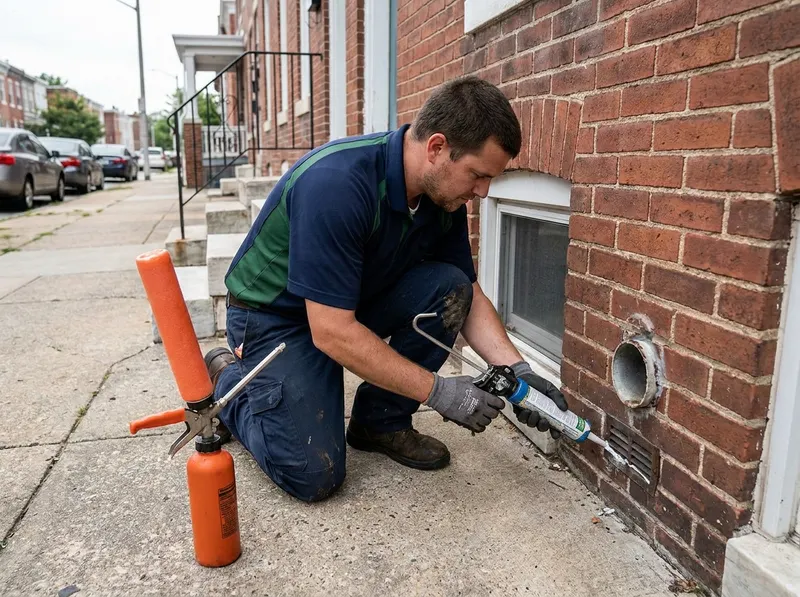
Crawling insect encounters inside living areas cause severe domestic distress, particularly when predatory house centipedes or perimeter moisture pests travel across interior drywall, baseboards, and food preparation surfaces. In Baltimore, historic housing stock presents unique structural vulnerabilities. The rubble stone foundations and shared brick party walls common in Fells Point, Canton, and Federal Hill settle over decades, producing hairline fractures and porous mortar joints that act as insect expressways. Unsealed crawlspaces and stone sub-basements near damp harbor zones provide the subterranean humidity that centipedes, silverfish, and sowbugs require for survival. When subterranean ambient humidity shifts or outdoor temperatures drop, these nocturnal predators move upward through floorboard margins, radiator pipe collars, and plumbing penetrations into residential rooms.
Physical exclusion delivers sustainable relief where surface chemical sprays fail. Chemical misting alone often scatters nocturnal insects into adjacent wall voids, driving them deeper into upstairs bedrooms. Mechanical exclusion instead establishes an impenetrable barrier between damp foundation masonry and finished living floors. In older rowhomes bordering Patterson Park and historic multi-family properties in Mount Vernon and Charles Village, exclusion specialists seal sub-base utility runs with non-toxic elastomeric sealants, pack pipe voids with copper mesh, and align mechanical sweeps beneath basement egress doors. In the standalone framed dwellings and daylight basements of Hampden, Locust Point, and Roland Park, exclusion plans extend to exterior band joists, masonry tuck-pointing, and grade-level weep-hole screen installation.
Decision guidance relies on identifying pest behavior versus domestic moisture levels. If multi-legged arthropods appear isolated within damp, unfinished basement corners, ambient dehumidification and targeted desiccant dust treatments behind utility walls resolve the issue. If active centipedes or silverfish surface on second-story ceilings, bathroom tile, or food prep zones, full physical exclusion is required to isolate structural utility chases. The practical trade-off centers on upfront repair labor versus recurrent pest pressure: surface aerosol applications cost less initially but require perpetual chemical reapplication, whereas foundational physical exclusion requires targeted carpentry and masonry labor to achieve non-chemical domestic security. Exclusion work maintains safe, same-day domestic pest containment by stopping migration pathways before perimeter treatments begin.
Every job gets a firm, written price after a free on-site visit.
Tell us about your crawling insect and centipede exclusion job in Baltimore and we'll send a clear, written quote, usually the same day.
 Zandora Pest Relief