Commercial kitchen pest management in Baltimore addresses the persistent vulnerabilities found in historic brick structures, converted rowhouse food spaces, and dockside establishments. In dense restaurant corridors…
Commercial kitchen pest management in Baltimore addresses the persistent vulnerabilities found in historic brick structures, converted rowhouse food spaces, and dockside establishments. In dense restaurant corridors like Fells Point along Thames Street, Canton near O'Donnell Square, and Federal Hill along Light Street, food operations frequently share party walls with adjacent residential units. This continuous wall void network allows Norway rats and German cockroaches to navigate utility conduits, floor sinks, and subfloor gaps. Operating in Baltimore City (an independent city) requires strict alignment with Baltimore City Health Department food facility regulations. Standard broad-spectrum aerosol treatments are avoided because airborne mists risk food-contact contamination and cause pest populations to scatter deeper into hollow stainless-steel prep tables and motor housings. Safe domestic-grade food safety procedures prioritize non-repellent structural bait matrices, insect growth regulators (IGRs), and mechanical pipe collar seals that keep food preparation surfaces intact and code-compliant.
Selecting treatment intensity depends on the kitchen's architectural profile and daily output volume. A fast-casual coffee bar in Mount Vernon or Charles Village with minimal hot grease accumulation requires focused preventative drain enzyme processing and exterior threshold seals to stop mice entering through alley doors. Conversely, historic full-service commercial cook lines in Hampden or Locust Point require intensive monthly biocidal cleaning of floor drains, motor compartment vacuuming using HEPA containment systems, and void injection along quarry tile grout lines. Choosing mechanical exclusion over repeated chemical sprays prevents chemical resistance in roaches and protects line cooks from inhaling harsh residues during prep shifts. While mechanical baiting requires precise physical labor under low-boy refrigeration units and dish pits, it eliminates the operational downtime associated with complete kitchen evacuations.
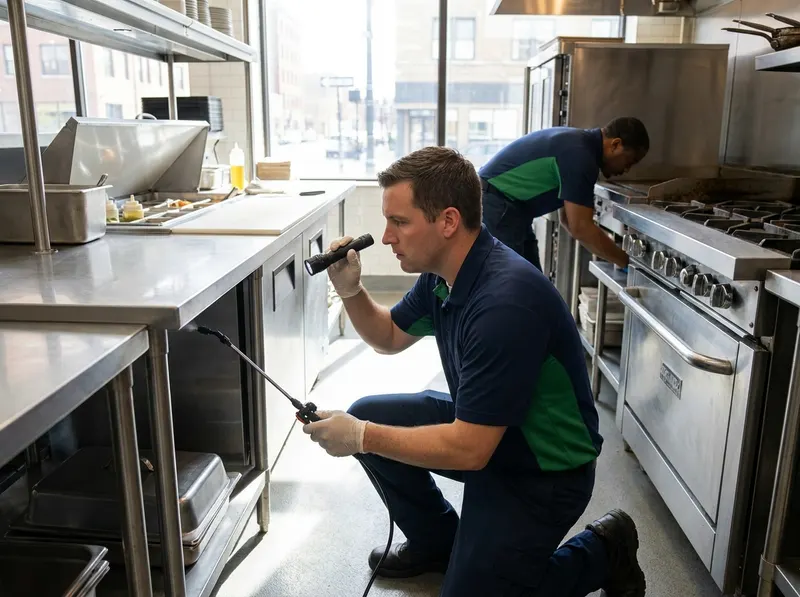
Food service directors in Roland Park private clubs and Patterson Park bakery kitchens experience distinct edge cases during seasonal transitions. In late autumn, rodents migrate inward from outdoor trash corrals toward radiant cook lines, requiring reinforced copper mesh packing around steam line pass-throughs. The diagnostic procedure follows four steps: 1. A physical audit of floor drains, motor compartments, and ceiling drops using high-intensity illumination. 2. The placement of tamper-resistant non-toxic monitoring stations behind major refrigeration equipment. 3. Direct application of EPA-registered gel baits and biological drain cleansers targeting hidden feeding pockets. 4. A formal digital regulatory logbook update left on-site for Baltimore City sanitarians.
Every job gets a firm, written price after a free on-site visit.
Tell us about your commercial kitchen pest management job in Baltimore and we'll send a clear, written quote, usually the same day.
 Zandora Pest Relief